
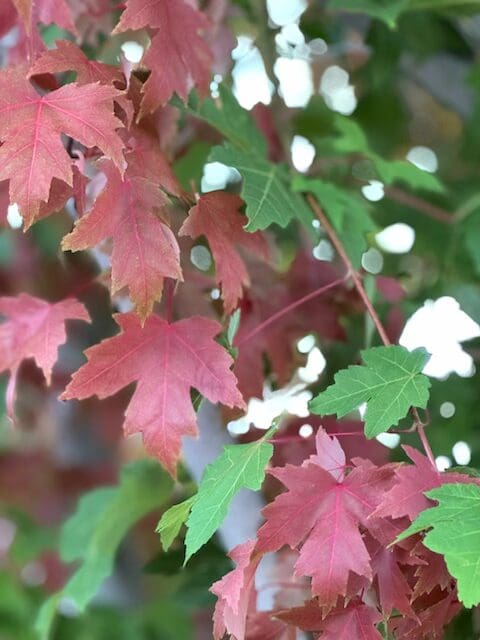
When I was taking a walk in my Northern Nevada neighborhood in late July, I saw something that made me stop in my tracks: a maple tree was turning a deep red. Did I fall asleep in July and wake up in October by mistake?
This wasn’t just one or two leaves. About two-thirds of the tree was changing color. The maple tree changing color early lasted until mid-August.
So what caused the tree’s internal clock to flip ahead to the fall when it’s supposed to be late summer?
Stressed Out Maple Trees
Turns out, when maple trees are changing color in July or August, the tree is likely stressed. Normally, in the fall, trees change to a red color because of pigments known as anthocyanins. However, if these pigments start to show up in the summer, it’s a red flag—pun intended—that the tree is stressed.
Read on to discover some of the factors that stress out a maple tree to the point of causing its leaves to drop early:
What’s Wrong with My Maple Tree?
If you were wondering “why is my maple tree leaves turning red in July?” here are some possible reasons:
[Editor’s note: This section contains some Amazon affiliate links. It costs you nothing to click on them, but allows us to continue to provide free content on this website by being an Amazon affiliate.]
Fungal Infections and Early Fall Color
An arborist who inspected some early changing maples in our area saw signs of a fungal infection. Maple trees are susceptible to fungal infections such as anthracnose or verticillium wilt.
You can use an organic fungicide, but fungicides are better to prevent the fungal infection in the first place rather than stop it once it starts. Spray the leaves in the spring when they’re emerging and then 10 days later.
Your best bet to prevent the fungus is to fertilize the tree in spring or fall, and make sure it’s getting enough water—but not too much water—throughout the year. A tree that’s in good health will be less vulnerable to fungal infections.
Iron Deficiency and Maples
Another common reason why your maple is changing color in July or August is that it may not be getting enough iron. I first learned about iron deficiency in maples from our local garden center when our tree, Marvin the Maple, was not thriving. After I dumped buckets of water containing an iron solution under the tree, Marvin looked good as new.
Iron deficiency in maples is called iron chlorosis. Autumn Blaze and Hot Wings Maples are the most vulnerable to this condition, although other types of maples can suffer from it as well.
Usually, iron deficiency causes leaves to turn yellow. However, in some cases, the stress on the tree can cause the leaves to turn red. There have been some reports of maple trees turning red due to iron and manganese deficiency caused by an alkaline soil.
High pH in the soil can make maple trees susceptible to iron chlorosis. When the pH soars above 7.5 to 7.7, it affects the way that the plant uses iron. Even if there is iron present in the soil, it’s not available to the maple.
You can lower the pH in the soil by adding iron sulfate every four to six months.
Deficiency of Other Nutrients
Maples have shallow root systems that don’t react well to overly saturated soils. Standing water can quickly stress their roots and deprive them of the oxygen they need.
Nitrogen or magnesium deficiency is also a common problem in maples that can lead to the leaves turning red in summer. Chlorophyll production can slow when the tree isn’t getting enough nitrogen or other nutrients, leading to the leaves changing early to red or yellow.
Pests and Maple Trees
Insects like spider mites and boxelder bugs, to name just a couple, can damage maple trees. Find a good organic pesticide at your local garden center to control infestations. If you catch the bugs early enough, the tree will likely be fine.
Each type of insect can cause characteristic damage to a tree, so it’s best to show someone at your local garden center a photo or bring a leaf into the store so they can identify the insect that’s causing the problem.
How Drought Affects Maples
If the maple tree isn’t getting enough water, it can trigger the production of the red pigments known as anthocyanins. This is a protective mechanism against further drought. A hot, dry summer can lead to a maple tree changing early, especially if it is thirsty.
Injury to Maples
Physical damage to the trunk caused by lawn mowers or compacted soil due to heavy foot traffic can all lead to problems with your maple tree.
What To Do When Your Maple Tree Is Changing in Summer
Whether your tree is changing early or you just want to keep it healthy and prevent it from turning color in the summer, here are some solutions:
• Bring in a leaf sample or a photo to your local garden center. They can help you identify if the problem is a fungus, iron deficiency, an insect, or another problem.
• Test your soil to determine which nutrients the tree is lacking. You can also test the pH of your soil. Use iron sulfate to bring down the pH if it’s too high. Here is a pH soil tester you can buy on Amazon that has other features like measuring soil moisture.
• Be sure your maple is getting enough water, especially in hot, dry summers or dry winters. Avoid overwatering.
• Fertilize your tree and nourish it with iron, nitrogen, and manganese.
• Rake up leaves in the fall to prevent overwintering of fungus.
